Showing posts with label Solutions. Show all posts

Wednesday, September 5, 2012

How to transition a classroom game into a larger event.

Many trainers use Gameshow Pro in their classrooms; in small-to-medium sized groups in a somewhat-intimate atmosphere. The energy it brings to the smaller training class is undeniable; it increases engagement, participation and content retention.

But can the small classroom solution translate into something like, say, a larger event? Sure a game show is fun in training a small group of sales reps, but what about in a room of 500? Will it even work? How does one even begin transitioning from a classroom game into a larger event game?

The answers are: Yes, game shows translate into large events. Yes, they invigorate a large group in the same way they add energy and interaction in a small group. Yes, it has worked time and time again.

And here are a few strategies and considerations for transitioning a classroom game into a game within a larger event:

Team selection: Whereas everyone in a small class may get to directly participate on a team, that's not always possible in a larger group. There are three options for team engagement in a big-group game show:
  1. Use audience-response keypads: If enough are available, giving everyone in the audience an audience response keypad is the most straightforward way of engaging everyone. Audience members can individually play along, but Gameshow Pro also allows you to group individuals on teams--creating a compelling, competitive dynamic. No "stage teams" are needed in this scenario.
  2. Use a mix of keypads and on-stage players: You may also want to have representative team members playing on stage to "ham it up" or to take the audience response into consideration for their answers.
  3. Use representative players on stage: Even if you have no keypads, you can engage and entertain everyone by selecting members of the audience to come play on a smaller team onstage. The rest of the audience members are still "part of" the team--they're responsible for cheering the team on and may reap some rewards if their team wins--but they don't have to directly interact with the game on stage. 
Host selection: While a small classroom game can be a scalable event--from a quiet Tic-Tac-Toe game to a rousing Classroom Feud--with a large event, bigger and broader is better. You'll want to make sure that your host is able to play to the crowd as well as team members, educate when needed, and to keep things moving. This doesn't need to be a professional emcee, but it should be someone who enjoys the spotlight and is very comfortable on stage--where anything can happen.

Simplify the rules: In a classroom you may have a chance to answer clarifying questions about the game rules as you go along. In a larger group this may not be possible, or it may be harder to control chaos from unclear rules as you go along. Make sure your game show rules are simple, clear and that everyone knows them. Playing a sample game question to get audience members familiar with the format, keypads and game logistics is a great idea.

Have someone else run the game: It's easy to click-through a game show (especially using Game Show Pro) and host at the same time in a smaller classroom. In a larger event setting, you'll want your computer hooked in to the A/V equipment and that may preclude you from controlling the game. Even if you do have access to the game controls, hosting and running through the game on stage in a large setting takes a lot more energy and focus than you'll want to spend. Get a colleague or technician to run the game software for you if you can.

Format selection: You may want to switch out a traditionally formatted game for alternate game play when bringing it on the big stage. For instance, we often make Tic-Tac-Toe into a Hollywood-Squares-Type game, utilizing different experts and presenters throughout the game.

When in doubt? Call in the experts. We'd be happy to help you transition your classroom game into a larger event.

Wednesday, August 17, 2011

Introducing: LearningWare Services


Introducing the launch of LearningWare Services! 

Why Utilize LearningWare Services?

Using games can improve your training immensely. Compatible with any type of training, they turn a potentially boring, dull or stagnant classroom experience into an engaging, fun and highly interactive session. 

When we entered the game show software market with our pioneering product-- Gameshow Pro--we knew that it would make learning more fun. But it surprised us to find that it also made learning more effective. We received reports from trainers that engagement and motivation were soaring, test scores zooming UP, etc. Since then, independent academic research has also confirmed that using game shows in a learning session can dramatically improve content retention and comprehension.

We now have over 15 years of game show experience, and have learned how to maximize the effects of games in the training classroom to completely engage every student. We even published a book—“I’ll Take Learning for 500; Using Game Shows to Engage, Motivate and Train”—on the subject, and have spoken as trusted experts on game shows in training at several training conferences and company events.

Bottom line? We want you to get the most out of using game shows in your training, whether it be:
            Compliance
            New Product Introductions
            Orientations
            Sales Training
            Webinars
            Safety
            HIPPA/OSHA/Etc.
            Audience engagement
            Academic classes (K-12 or Collegiate level)
            Or any other training session

Consulting Services:
We'll help you integrate games into training to maximize engagement and retention. We'll consult with you to understand your training objectives and put you on a course to successfully implement games. We'll show you:
            - Where to implement games
            - How to put them into practice smoothly (including hosting training, etc.)
            - What games to use and when
- How to design your game, develop your questions, set up your session, etc.

We’ve consulted with dozens of clients on game show utilization including: Procter & Gamble (Marketing University), Johnson & Johnson, Mystic Tan, Intel, Toyota, Lawson Software, Transamerica, Onyx Pharmaceuticals, Comcast, etc.


Custom Game Development:
We'll develop a classroom or web-based games that is perfect for you. This can include large-scale audience response games, branded games with custom graphics, unique game play formats, etc. Our in-house programmers work with you to make a game show solution that will revolutionize your training or event, and looks like nothing else out there.


Train-the-Trainer Workshops
We want your game show roll-out to be smooth and successful. We offer train-the-trainer workshops to ensure that everyone in your organization is up to speed on game show implementation for their training sessions. These workshops are highly interactive, and will teach:
-       The where-when-how of using game shows in training
-       Question creation best practices
-       Setting up the rules and games in your software
-       Choosing the best game for your content
-       Hosting best practices and tips

Depending on your need and workshop format, experts will be on hand to walk each attendee through creating their first games; this means that everyone will leave the session absolutely primed for a successful first game show experience.

Large Scale events
We’ll work with you to produce a game show at your next tradeshow, conference or workshop that will engage your entire audience.

Our production ranges from on-site implementation of existing game shows, to custom game design using audience-response systems, and everything in between.

Game shows can be used in a large event as:
-       Main-stage entertainment
-       A teambuilding activity
-       A competition throughout the event
-       A unique presentation sure to be remembered
-       A review tool after key presentations
-       An evening activity
-       A featured trade show attraction
-       A tool to make workshops/breakouts incredibly engaging

We’ll consult with you to make sure your game design is flawless and be onsite to ensure that it is executed perfectly.

Monday, February 23, 2009

Custom Game Shows: The Seagate Case Study

LearningWare is pleased to be not just the provider of game show software, but also of solutions. LearningWare can create interactive solutions (with game shows or not) for your training session, curriculum or event through our LearningWare Services division (in partnership with its sister company, Live Spark). What follows is one example of LearningWare creating a custom game show to suit the needs of the trainer.
Summary: Seagate needed a way to engage their audience in traditionally dry breakout sessions. Live Spark created three different custom audience-response game shows that were played in each of the three breakout sessions throughout the session. The games were not only well received, but the audiences’ attention and retention of the material soared; as did the energy of both the presenters AND the attendees.

Overview: Seagate was getting all their local and international sales reps together for a large annual event. Part of this event included 90-minute workshops training on everything from product roadmaps, to new product introductions and sales strategies. Audience members cycled through the four major workshops in regional groups; from the Americas, to Europe, to Asia to Canada.

Issues: The extended workshop sessions were trying on the attention span of the attendees. A large amount of very important information needed to be presented, so presenters were scheduled back-to-back, giving attendees very little time to process and absorb the information. This was not conducive to learning.

Pile on top of that the fact that a lot of the material was very technical and could be dry. It was a recipe for attendees to check out of the breakout and check their Blackberries instead.

Solution: Live Spark designed three unique audience-response game shows that took place throughout three of the breakout sessions. They were a baseball-themed game, a quick-quiz game, and a “Get Smart” game.

Each audience member had a keypad waiting for them when they walked in the door. Depending on the game type, audience members were either playing individually (with the score of the highest keypads winning the game) or on teams. The games were introduced first thing, and a sample question was played.

After every presenter, a game show session took place. The content for the game show was based on the presentation the attendees had just heard—with the exception of the final round at the end of the workshop; which was a compendium of questions.

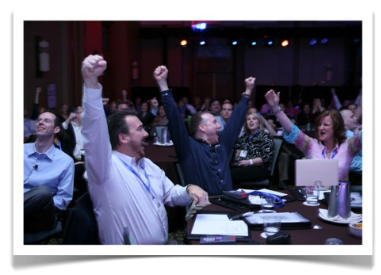
Why it worked: When the first question of the first round was played, and the audience found out how they scored in a dramatic, building fashion, the room erupted into cheers—led by the team with the highest score on that question. The energy, instead of draining with each progressive speaker, was refreshed and renewed in between every presentation. Not only that, but speakers highlighted the content that was going to be in the game show later—bringing out key points that were reinforced through the highly emotional game show experience.

Everyone in the audience was engaged. They were engaged during the game show--each playing along with their own keypad—but, perhaps more importantly, they were engaged DURING the speaker presentations. No one, after all, wanted to miss a question in the game show because they failed to hear a fact or key point during the presentation.

Because game shows are a somewhat-universal medium, there was no difficulty getting even international groups to play along.

Reactions: Seagate--the speakers, audience members, and organizers—were extremely happy with the game show.

”I didn’t believe you when you said they’d start cheering with the first score,” an event organizer remarked, “But this is simply amazing. Everyone is engaged.”


Audience members, knowing the next workshop was going to contain a game of some sort, were a-buzz in the hallways, talking with their peers about which session they had just come from; what game they played, who won, and which questions stumped them.

It was the most widely successful breakout session event that Seagate had ever had, and we’re happy to report that there was a distinct lack of Blackberry-checking.